
Best Inventory Management Software for Shopify (The Honest Buyer's Guide)
Compare the best inventory management software for Shopify in 2026. AI forecasting, multi-channel sync, Square support, and a buyer's checklist included.
Running a Shopify store is exciting until your inventory starts running you. Overselling, stockouts, and manual tracking errors can quietly drain your revenue and damage customer trust faster than almost any other operational problem. If you have outgrown Shopify's native inventory tools and are ready to level up, you are in the right place.
Finding the best inventory management software for Shopify is not just about picking the app with the most features. It is about finding the right fit for your specific store size, sales channels, and growth goals. The wrong choice can mean wasted money, a steep learning curve, and integrations that never quite work the way you need them to.
In this guide, we cut through the marketing noise and give you an honest breakdown of the top inventory management solutions built to work with Shopify. You will learn what each tool does well, where it falls short, and which type of seller it suits best. Whether you manage a single warehouse or sell across multiple channels, this list will help you make a confident, informed decision.
The Real Cost of Getting Inventory Wrong on Shopify
Inventory errors are not minor operational hiccups. According to research from IHL Group, retailers worldwide lose more than $1.75 trillion annually to the combined impact of stockouts and overstock, and small-to-midsize businesses absorb a disproportionate share of that damage. Unlike enterprise retailers with deep capital reserves, lean Shopify merchants operate on thin margins where a single oversold product or a warehouse full of stagnant SKUs can derail an entire quarter. The problem starts small and compounds fast, especially when the tracking infrastructure underneath the business was never built to scale.
Shopify's built-in inventory tools and spreadsheet-based systems create a dangerous false sense of control. During high-velocity periods like Black Friday or seasonal peaks, manual tracking simply cannot keep pace with order velocity. Merchants routinely discover oversold inventory only after customers have checked out, triggering order cancellations, refund requests, and a wave of negative reviews that damage long-term brand trust. As Shopify's own inventory management guide acknowledges, effective inventory management requires systems that go well beyond native platform defaults.
Overstock is equally destructive, just quieter. Cash locked in excess inventory cannot fund new SKU launches, marketing campaigns, or supplier negotiations. Storage costs accumulate on stock that is not moving, while purchasing power for high-potential products evaporates. This is the silent growth ceiling that prevents many capable Shopify operators from scaling.
The problem intensifies for merchants selling across both Shopify and Square simultaneously. Without a dedicated synchronization layer, inventory counts across those two platforms diverge in real time, creating structural oversell risk at every transaction.
Critically, investing in the wrong inventory tool does not solve these problems; it deepens them. As leading ecommerce software evaluations consistently show, evaluation criteria including real-time tracking, demand forecasting, and multi-channel sync must guide every purchase decision. The choice of tool matters as much as the decision to invest at all.
How We Evaluated These Tools
Not all inventory tools are built the same, and a feature checklist alone will not tell you which platform will actually perform under real Shopify operating conditions. To build this list, we evaluated each tool against five weighted criteria designed to separate genuine capability from marketing language.
AI forecasting depth was our most scrutinized criterion. We looked beyond "AI-powered" badge claims to assess whether a tool uses genuine machine learning demand models trained on historical sales patterns, seasonality, and external signals, or whether it simply applies fixed reorder-point thresholds dressed up with modern terminology. Tools that quietly restrict predictive features to high-velocity SKUs were penalized, since most SMB catalogs include slow-moving or seasonal products that need forecasting support the most.
Shopify-native integration quality was evaluated on bidirectional sync speed, variant-level tracking granularity, and compatibility with Shopify's Spring 2026 platform updates, including Agentic Storefronts. A sale on Shopify must deduct stock in the app instantly, not on a polling delay.
Multi-channel and Square POS support assessed whether platforms handle Shopify alongside Square without requiring manual reconciliation, a gap that remains surprisingly underserved across the category.
SMB accessibility considered transparent, flat-rate pricing, onboarding complexity without a dedicated data team, and free trial availability.
Real-world reliability signals drew from Shopify App Store ratings and third-party editorial sources, uptime history, and support responsiveness, prioritizing tools with verified organic user reviews over self-promotional content.
Quick Comparison: Top Shopify Inventory Tools at a Glance
With over 1,000 inventory apps available on the Shopify App Store, having a quick-reference comparison saves hours of research. The table below is designed specifically for dual-platform merchants and growth-stage Shopify brands who need a decision shortcut before diving into full tool breakdowns.
Tool | Best For | AI Features | Square Support | Free Trial | Starting Price |
|---|---|---|---|---|---|
Invyra | Shopify + Square merchants | AI demand forecasting, real-time multi-channel sync | Yes | 14-day free trial | Contact for pricing |
Prediko | SMB Shopify brands | AI demand planning, AI replenishment, "Pia" AI agent | No | Yes | Free to install |
Inventory Planner | Forecasting-focused SMBs | Demand forecasting (Sage-owned) | No | Yes | Contact for pricing |
Cin7 | Scaling/enterprise operations | ForesightAI forecasting add-on | No | Limited | Contact for pricing |
Linnworks | Enterprise multi-channel | Basic automation | No | No | Enterprise pricing |
NetSuite | Large enterprise, full ERP | Limited | No | No | Enterprise pricing |
Two patterns stand out immediately. First, Invyra is the only tool in this group that natively supports both Shopify and Square POS, making it the clear starting point for merchants operating across both platforms. Second, Cin7, Linnworks, and NetSuite are enterprise-tier platforms with pricing and onboarding complexity that places them out of reach for most SMBs. Invyra, Prediko, and Inventory Planner represent the SMB-accessible tier, with lower barriers to entry and trial availability that lets you validate fit before committing. If Square integration is non-negotiable for your operation, you can filter this list down to one option instantly.
The 10 Best Inventory Management Tools for Shopify
1. Invyra: Best Overall for Shopify and Square Merchants
Invyra earns the top position on this list because it is the only AI-powered inventory management platform purpose-built for merchants operating across both Shopify and Square simultaneously. While most tools on this list treat Shopify as their sole focus, Invyra recognizes that a significant portion of modern retailers run an online storefront alongside a physical point-of-sale environment, and those two systems need to speak to each other in real time. Its dual-platform synchronization ensures that a sale made in-store on Square immediately updates available inventory on your Shopify storefront, eliminating the costly overselling errors that frustrate customers and damage brand trust.
Beyond sync, Invyra's AI-driven demand forecasting is where the platform genuinely separates itself from older-generation tools. Rather than relying on static reorder points or manual spreadsheet reviews, Invyra's AI engine analyzes historical sales velocity, seasonal patterns, and channel-specific demand signals to generate replenishment recommendations automatically. This means a lean SMB team can make smarter purchasing decisions without needing a dedicated inventory analyst on staff. The platform also offers real-time tracking across all stock locations, giving merchants a single source of truth for inventory levels regardless of how many warehouses, storefronts, or fulfillment centers they operate. Invyra offers a free 14-day trial, making it one of the lowest-risk entries on this list for merchants who want to validate the platform against their actual data before committing.
2. Prediko: Best AI-Native Tool for Shopify-Only Merchants
Prediko has built a strong reputation as an AI-first inventory management application designed specifically for Shopify merchants, and its feature set reflects genuine depth in that focus area. The platform includes AI Demand Planning, AI Supply Planning, an AI Replenishment Buying Table, and Purchase Order Management as core modules. Its standout feature is "Pia," an AI inventory agent positioned as a conversational co-worker that can surface insights, flag risks, and guide replenishment decisions through a natural-language interface. For Shopify merchants who are serious about leveraging AI in their operations, Prediko's messaging and product architecture are among the most sophisticated currently available in the app ecosystem.
That said, Prediko has notable limitations worth considering before committing. According to available source materials, the platform does not mention Square POS support, which immediately disqualifies it for omnichannel merchants running hybrid retail models. Pricing transparency for SMBs is also limited in publicly available information, making it harder to evaluate total cost of ownership without going through a sales conversation. Prediko is an excellent choice for digitally native, Shopify-exclusive brands with mature inventory data and forecasting ambitions, but merchants who need cross-platform coverage or straightforward SMB pricing will find Invyra's offering more complete. You can explore Shopify's demand forecasting software roundup for additional context on how AI forecasting tools are being evaluated across the ecosystem.
3. Inventory Planner: Best for Data-Mature Merchants Who Value Forecasting Depth
Inventory Planner has been a fixture in the Shopify ecosystem for several years, and its longevity reflects genuine utility. The platform specializes in demand forecasting and replenishment planning, with a Shopify integration that handles complex product catalogs, seasonal SKUs, and multi-location stock management. Merchants with substantial historical sales data and established operational workflows will find Inventory Planner's forecasting engine reliable and well-calibrated. It surfaces replenishment recommendations based on lead times, sales trends, and reorder thresholds, giving buyers a structured framework for purchase order decisions.
The primary limitation is that Inventory Planner has not evolved as aggressively into AI-native territory as newer entrants. Its forecasting is robust, but it relies more heavily on rules-based logic and historical trend analysis than on the kind of machine-learning-driven prediction modeling that platforms like Invyra and Prediko are delivering in 2026. For merchants who are comfortable with data-driven planning tools and do not require an AI agent or natural-language interface, Inventory Planner remains a credible and dependable option. However, merchants scaling rapidly or operating in high-velocity categories may find that its forecasting accuracy lags behind more modern alternatives as their business complexity grows.
4. Cin7 Core: Best for Enterprise-Scale Multi-Channel Operations
Cin7 Core is a comprehensive multi-channel inventory and operations platform that positions itself at the enterprise end of the Shopify ecosystem. With over 700 integrations spanning sales channels, 3PLs, accounting platforms, and warehouse management systems, Cin7 offers an operational breadth that few competitors can match. Its ForesightAI add-on brings machine-learning-based demand forecasting into the platform, and its operational tracking capabilities are cited by independent analysts as among the strongest available for merchants managing complex, high-SKU environments across multiple channels simultaneously.
The honest assessment, however, is that Cin7 Core is almost certainly overkill for the majority of Shopify SMBs. The platform's depth of functionality comes with corresponding complexity in implementation, onboarding, and ongoing administration. Pricing reflects its enterprise positioning, meaning lean teams without dedicated operations staff will likely struggle to extract full value from the system and may find themselves paying for capabilities they rarely use. Cin7 makes excellent sense for a Shopify merchant running a seven-figure-plus operation with a dedicated ops team and complex fulfillment requirements. For everyone else, a more focused and accessible tool will deliver better return on investment.
5. Katana Manufacturing ERP: Best for Shopify Merchants Who Manufacture Products
Katana occupies a very specific and genuinely useful niche: it is the go-to inventory management platform for Shopify merchants who also manufacture the products they sell. The platform handles production scheduling, bill of materials management, raw materials tracking, and work-in-progress inventory in ways that pure retail inventory tools simply are not designed to do. For a Shopify brand that assembles, kits, or produces its own goods, Katana provides a level of operational visibility that generic inventory tools cannot replicate. Its Shopify integration ensures that finished goods inventory stays synchronized with the storefront as production batches are completed.
The critical caveat is that Katana is built around manufacturing workflows, not retail inventory management. Merchants who source finished goods from suppliers and sell them through Shopify and other channels will find that Katana's feature set does not align with their operational priorities. There is no meaningful AI-driven demand forecasting, no multi-channel POS synchronization for retail environments, and no automated replenishment logic equivalent to what Invyra or Prediko offer. Katana is the right tool only if manufacturing is central to your business model. If it is not, selecting a platform built for retail inventory management will serve you significantly better.
6. Stock Sync: Best for Dropshippers and Supplier Feed Management
Stock Sync addresses a specific and common pain point for Shopify merchants: keeping inventory levels accurate when stock is managed by external suppliers or distributed across multiple warehouse locations. The platform specializes in automating supplier feed imports, synchronizing stock updates from vendor data files, and pushing those updates across connected sales channels. For dropshippers and wholesale-to-retail merchants who rely on supplier-controlled inventory, Stock Sync reduces the manual overhead of keeping Shopify product listings current and prevents overselling on products that may have sold out at the supplier level.
Where Stock Sync falls short is in forecasting intelligence. The platform is fundamentally a synchronization and data-pipeline tool rather than an AI-powered inventory optimization platform. It does not generate demand forecasts, recommend reorder quantities, or analyze sales velocity to surface buying opportunities. Merchants who need more than feed management, who want their inventory tool to help them think proactively about what to order and when, will quickly outgrow what Stock Sync offers. It is a practical tactical solution for a specific use case, but it should not be confused with a full inventory management platform.
7. SKULabs: Best for High-Volume Warehouse Fulfillment Operations
SKULabs is built around the operational realities of warehouse fulfillment: barcode scanning, pick-and-pack workflows, shipping label generation, and multi-carrier integrations. For Shopify merchants running high-volume fulfillment operations who need to optimize the physical process of moving product out the door accurately and quickly, SKULabs provides a purpose-built environment that general inventory management tools are not designed to replicate. Its barcode scanning interface reduces picking errors, and its shipping workflow integrations streamline the carrier selection and label printing process for operations processing hundreds or thousands of orders daily.
The narrow focus that makes SKULabs valuable in a warehouse context is also its primary limitation for general Shopify inventory management. The platform does not offer AI-driven demand forecasting, multi-channel inventory synchronization across POS environments, or automated replenishment recommendations. Merchants whose primary challenge is inventory planning, buying accuracy, or multi-channel stock visibility will find SKULabs underwhelming outside of its fulfillment niche. It is best considered a warehouse operations tool that complements an inventory management platform rather than a standalone replacement for one.
8. Linnworks: Best for Large Catalog Merchants Across Multiple Marketplaces
Linnworks is a multi-channel inventory and order management platform that has established a strong presence among mid-market and enterprise merchants selling large product catalogs across numerous marketplaces simultaneously. The platform handles inventory synchronization, order routing, and listing management across channels including Shopify, Amazon, eBay, and others, providing a centralized operational hub for merchants with significant marketplace presence. Its depth of channel coverage is a genuine asset for merchants whose Shopify store is one of many active sales channels rather than their primary or only storefront.
The challenges with Linnworks for most Shopify merchants come down to fit and cost. The platform is not AI-native; its forecasting and replenishment capabilities rely on more traditional rule-based approaches rather than machine-learning-driven prediction. Pricing is structured for mid-market and enterprise organizations, making it cost-prohibitive for SMBs operating with lean budgets. Merchants who are primarily Shopify-focused, or who run Shopify alongside a single additional channel like Square POS, will find that Linnworks' complexity and pricing structure far exceed what their operational needs justify. Shopify's inventory management software guide provides useful context on matching tool complexity to business scale.
9. Cogsy: Best for DTC Shopify Brands Focused on Purchase Order Automation
Cogsy has earned recognition among direct-to-consumer Shopify brands for its clean user interface and focused approach to demand forecasting and purchase order automation. The platform surfaces replenishment recommendations based on sales velocity and lead times, generates purchase orders with minimal manual intervention, and presents inventory data in a dashboard designed for founders and operators who want actionable insight without overwhelming complexity. For a pure DTC Shopify brand with a focused product catalog and no physical retail presence, Cogsy delivers a genuinely useful and approachable planning workflow.
The limitations become apparent when multi-channel or POS requirements enter the picture. Cogsy's support for omnichannel inventory environments, particularly those that include physical retail through platforms like Square, is limited compared to what Invyra offers. Merchants selling through both an online storefront and a brick-and-mortar location will find that Cogsy cannot unify those environments into a single inventory view with the same depth of synchronization. Additionally, while Cogsy's forecasting is solid, it does not yet offer the kind of AI-agent-driven replenishment intelligence that positions a platform as genuinely future-ready in the 2026 landscape. It is a good tool for a specific use case, but it has a clear ceiling.
10. NetSuite (Oracle): Best for Complex Multi-Entity Operations With Dedicated IT Resources
NetSuite is not an inventory management app in the conventional sense; it is a full enterprise resource planning suite for which inventory management is a single module among many. For Shopify merchants operating at the scale of multi-entity organizations, with complex intercompany transactions, multi-subsidiary reporting, and dedicated IT and finance teams managing the implementation, NetSuite provides an integrated operational foundation that purpose-built inventory tools cannot replicate. Its depth of financial integration, compliance tooling, and cross-entity reporting makes it appropriate for organizations that have genuinely outgrown standalone operational software.
For any SMB reading this list, NetSuite is almost certainly the wrong answer. Implementation requires significant professional services investment, ongoing administration demands dedicated IT resources, and the licensing costs are structured for organizations with corresponding revenue scale. The platform's inventory capabilities are robust but exist within a system whose complexity and cost are calibrated for a very different type of organization than a lean Shopify merchant trying to reduce stockouts and improve purchasing decisions. If your operation requires NetSuite, you likely already know it, and you have the infrastructure to support it. If you are evaluating inventory tools for the first time or scaling through the SMB tier, every other option on this list will serve you better before considering a full ERP deployment.
The Shopify and Square Inventory Problem Nobody Talks About
Picture this scenario: a boutique owner runs her online store through Shopify and sets up a Square POS terminal every Saturday at a local farmers' market. Every in-person sale she completes on Square depletes physical stock, but her Shopify storefront has no way of knowing that. By Sunday morning, she has oversold three products to online customers who will need refunds, and her weekend started with a manual inventory count she has to reconcile by hand.
This is not an edge case. It is the operational reality for thousands of Shopify merchants who blend online and physical retail using Square. The two platforms do not natively sync inventory with each other, which means every sale on either system creates an immediate divergence between what is actually in stock and what customers can see available online. The consequences compound quickly: overselling triggers refund requests, damages customer trust, and consumes staff time that should be spent on growth.
What makes this problem particularly frustrating is that the best multi-channel inventory management software roundups published in 2026 simply do not address it. Major reviews from getcarro.com, xstak.com, and others cover integrations with Amazon, eBay, TikTok Shop, and Walmart without a single mention of Square POS as a named use case. Merchants searching specifically for "inventory management for Shopify and Square" or "Square Shopify inventory sync" encounter a landscape of articles that were not written with their operation in mind.
Patching the gap with third-party middleware or connector tools introduces its own risk. In 2026, real-time sync is the baseline industry expectation; any connector that introduces polling delays creates a dangerous window during busy in-store periods when overselling is most likely to occur.
Invyra addresses this directly. Its multi-channel synchronization covers both Shopify and Square simultaneously without requiring third-party connectors or custom API configuration. When a Square sale closes in person, Invyra updates Shopify stock in real time, closing the reconciliation gap that currently has no purpose-built solution in any major 2026 roundup.
Why AI Forecasting Is Not All Created Equal
In 2026, "AI-powered" has become the default marketing label for nearly every inventory tool on the Shopify App Store. The problem is that the term covers an enormous range of actual capability, from genuine machine learning models trained on multi-variable demand signals to basic moving averages dressed up with AI branding. For Shopify merchants making purchasing decisions, this gap in methodology is not an abstract technical concern. It translates directly into stockouts during peak seasons, overstock after promotions end, and wasted ad spend on campaigns your inventory cannot actually support.
The Difference Between Real AI and Rebranded Rules
The most important distinction to understand is between rule-based reorder logic and true demand modeling. Rule-based systems set a fixed reorder point, typically a static number, and trigger a purchase order when inventory falls below that threshold. These systems can be labeled "AI-powered" without ever running a machine learning model. Genuine AI demand forecasting works differently: it ingests historical sales velocity, seasonal trend data, promotional lift patterns, and lead time variability from suppliers to generate replenishment recommendations that update continuously as new signals arrive. According to research comparing leading Shopify inventory forecasting tools, the difference in outcomes becomes most visible during demand spikes, new product launches, and high-velocity promotional windows, precisely the moments when merchants can least afford a wrong prediction.
When Shallow AI Fails You Most
Shallow AI forecasting has a specific and predictable failure pattern. It performs adequately during stable, repetitive demand cycles because its underlying logic was designed for that environment. The moment demand becomes non-linear, such as during a flash sale, a new product launch with no sales history, or a seasonal spike driven by external factors, fixed-schedule models fall apart. A model that updates weekly cannot respond to a viral social post that drives three days of compressed demand. A reorder-point rule cannot account for a supplier whose lead time just increased by ten days. These are not edge cases for Shopify merchants. They are regular operating conditions.
What True AI Forecasting Actually Incorporates
According to analysis of the top inventory forecasting software tools for 2026, the most capable systems combine several variables that shallow tools ignore entirely. These include SKU-level and variant-level sales velocity, not just product-level aggregates; dynamic safety stock calculations that adjust based on demand variability rather than static buffers; promotional lift modeling that estimates the inventory impact of upcoming campaigns; and lead time variability from supplier performance history. The output is a replenishment recommendation that reflects current reality rather than a historical average.
Shopify's Spring 2026 Edition reinforced why this matters. The platform introduced more than 150 updates, including Agentic Storefronts and Campaign Autopilot, features that allow AI to execute merchant workflows autonomously rather than simply advise on them. As noted in The Retail Exec's 2026 AI inventory software ranking, the entire Shopify ecosystem is now moving toward AI that operates without manual intervention. An inventory tool that requires a merchant to manually export data, reconfigure models, or override static rules on a fixed schedule is working against the direction of the platform itself.
How Invyra Approaches This Problem for SMB Operators
Invyra's demand forecasting is built for the merchant who does not have a data science team reviewing model outputs every morning. The system processes historical sales velocity, seasonal patterns, and lead time data automatically, surfacing actionable reorder recommendations without requiring manual configuration. There are no data exports to run, no forecast parameters to tune, and no threshold rules to maintain. The model updates in real time as sales data flows in from connected Shopify and Square channels, meaning a demand shift that starts on a Tuesday afternoon is reflected in replenishment recommendations before it becomes a stockout on Thursday.
Three Questions to Ask Any Vendor
Before accepting any tool's AI claims at face value, ask three specific questions. First, what data inputs does the forecasting model actually use, and does it operate at the variant level or only at the product level? Second, how does the system handle seasonality, and can it distinguish between a genuine demand trend and a one-time spike? Third, does the model update forecasts in real time based on incoming sales data, or does it run on a fixed daily or weekly schedule? The answers to these three questions will tell you more about a tool's actual capability than any marketing claim on its product page.
Buyer's Checklist: 8 Questions to Ask Before Choosing an Inventory Tool
Before committing to any inventory platform, run every candidate through these eight questions. The answers will reveal far more than any feature checklist or demo video.
1. Does it sync bidirectionally with Shopify in real time, or does it rely on batch updates? Batch-updating tools may refresh inventory every 15 to 60 minutes, meaning a sale made online could leave your POS showing phantom stock for the better part of an hour. For high-velocity SKUs during peak periods, that lag is enough to generate oversells, customer complaints, and manual cleanup. Confirm explicitly whether the sync is event-triggered and instantaneous in both directions.
2. If you sell on Square, does the platform support it natively? A third-party connector between your inventory tool and Square is an additional failure point, an additional subscription cost, and an additional support relationship to manage when something breaks. Ask vendors directly whether Square is a first-party integration built and maintained in-house, or whether you would be routing data through a middleware layer. This distinction is rarely visible on a features page. You can use Shopify's retail inventory software guide as a baseline reference for what native integration should look like.
3. What does the AI forecasting actually do, concretely? There is a significant operational difference between a tool that surfaces a demand chart and one that generates a ready-to-send purchase order recommendation based on sales velocity, seasonality, and supplier lead times. Ask for a live demonstration of the forecasting output, not a slide. If the AI produces a recommended order quantity with a suggested send date, that is actionable. If it produces a graph and leaves the next step to you, that is a reporting tool wearing an AI label.
4. How long does onboarding take, and what support is included? For a lean team without dedicated IT staff, implementation complexity is a real operational risk. Ask whether the vendor provides live onboarding sessions or only documentation. A tool that takes three weeks to configure against your SKU catalog is a tool that costs you money before it saves you any.
5. Is pricing publicly listed, or does it require a sales call? Opaque pricing is a proxy for pricing that does not scale well for SMBs. Vendors with transparent, published tiers respect your time and signal that their plans were designed with smaller merchants in mind. Choosing inventory apps for Shopify is a useful resource for benchmarking what transparent SMB-friendly pricing structures typically look like across the category.
6. Is a free trial available without a credit card requirement? A trial that requires a credit card upfront creates psychological commitment before you have validated anything. A genuinely risk-free trial lets you import your actual SKU catalog, connect your live Shopify store, and confirm the platform performs under your real operating conditions before you spend a dollar. Invyra offers a 14-day free trial without requiring a credit card, which is the standard worth holding every other vendor to.
7. Does it support multi-location inventory across warehouses and retail outlets simultaneously? If you operate a fulfillment warehouse alongside one or more physical retail locations, you need the platform to track stock at each node independently while maintaining accurate aggregate availability across channels. Confirm whether location-based inventory is included in your plan tier or priced as an add-on.
8. What do reviews from merchants your size actually say about support response times? Aggregate star ratings obscure critical detail. Filter for reviews from merchants with a comparable catalog size and channel mix to yours, and look specifically for comments about support responsiveness during high-traffic periods like Black Friday. A vendor with strong BFCM performance data or published merchant case studies from peak-season operations is demonstrating support reliability where it matters most.
Final Verdict: Choosing the Right Tool for Your Shopify Store
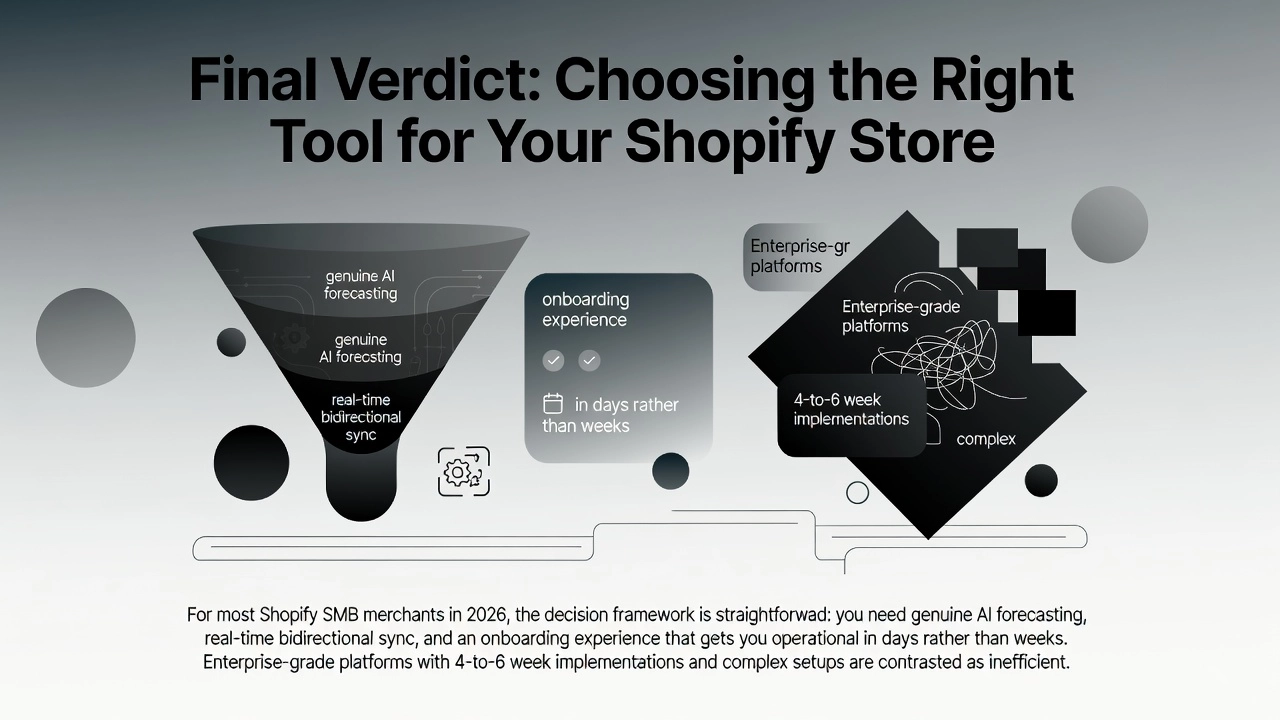
For most Shopify SMB merchants in 2026, the decision framework is straightforward: you need genuine AI forecasting, real-time bidirectional sync, and an onboarding experience that gets you operational in days rather than weeks. Enterprise-grade platforms with 4-to-6 week implementations and complex pricing tiers solve problems most SMBs will never have, while creating friction that slows adoption from day one.
If your business operates across both Shopify and Square, your shortlist narrows further. Invyra is the only tool in this roundup that natively addresses both platforms without requiring a third-party connector or middleware layer. That single distinction eliminates a category of sync errors, reconciliation delays, and integration maintenance costs that erode the value of otherwise capable tools.
Before starting any free trial, run every candidate through the buyer's checklist covered earlier in this post. It surfaces compatibility gaps and deal-breakers before you invest time configuring a platform that will not fit your workflow.
Invyra's 14-day free trial is specifically designed for live validation. Connect your actual SKU catalog, run your real sales channels, and measure AI forecasting accuracy and sync latency against your own data. No synthetic demos, no curated datasets.
Ultimately, the best inventory tool is the one you will actually use consistently. Prioritize workflow fit and onboarding simplicity over feature count. A tool with 200 features you never configure delivers less value than a focused platform you adopt completely from week one.
Conclusion
Choosing the right inventory management software for Shopify does not have to be overwhelming. Keep these key takeaways in mind as you decide:
No single tool is perfect for every store; your size, channels, and budget matter most
The best software grows with you, reducing manual errors and protecting customer trust
A poor fit costs more than the subscription fee in lost time and missed sales
Free trials exist for a reason, so use them before committing
Now it is time to stop letting inventory problems quietly eat into your profits. Pick the top one or two tools from this guide that match your current stage, sign up for a trial, and see the difference firsthand. The right system will not just organize your stock. It will free you to focus on what actually grows your business.